On Perdido Key, the Beach Behind the Condo Has Its Own Paperwork
Since 2023, a Gulf-front property on Perdido Key has been allowed one no trespassing sign per property line. The sign has to sit 10 feet from the dune line, measure no more than 24 by 24 inches and stand no taller than six feet. Escambia County commissioners passed that rule 5-0, cutting the earlier limit of three signs, according to Mullet Wrapper.
That small, square sign shows how beach ownership works on the Key. How private the sand behind a Gulf-front condo really is depends on which stretch of shoreline the building sits on. It depends on what a 1957 deed says about that stretch, and on how far the building is from the nearest public access. Escambia County is now putting those factors on a map, one stretch at a time.
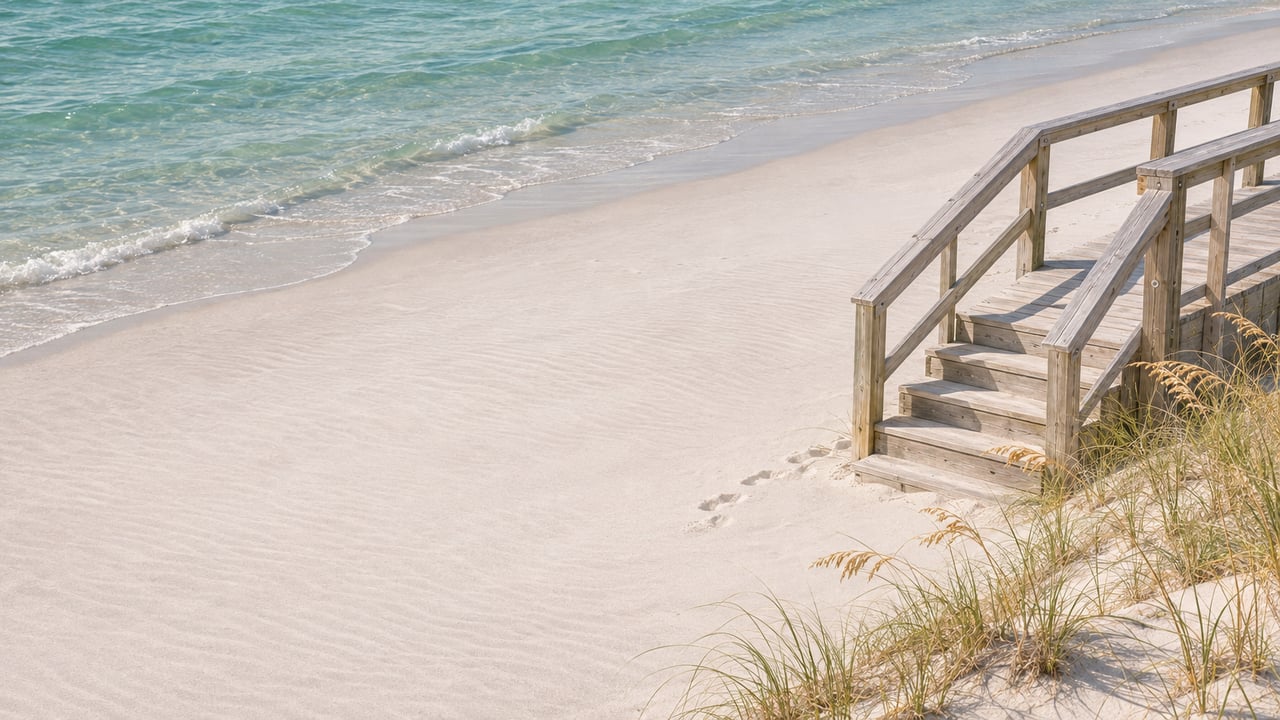
Florida's split is simple to state. The public has guaranteed access to the wet sand below the mean high-water line. The dry sand above that line is often privately owned, and the Pensacola News Journal reports that it's where the arguments over signs, ropes and tape take place.
The line between those layers isn't fixed. Tim Day, deputy director of Escambia County Natural Resources, told commissioners in February 2026 that mean high water "shifts daily with the tides." He said surveys and maps are needed to show where it falls, as WUWF reported. So the boundary of a condo's "private" sand moves with the tide, even before any law or deed comes into it.
For one stretch of the Key, the question was answered decades before the current debate. Deeds from 1957 that conveyed 64 Gulf-front lots made the southerly 75 feet of each lot subject to a perpetual easement for public beach use. Once those deeds turned up again, about 1.2 miles of beach thought to be exclusive was open to the public, Mullet Wrapper reported.
Six condominium associations, La Riva III, Portico, Mirabella, Ocean Breeze, the Palms of Perdido and Windemere, sued Escambia County in 2024. They wanted a court to decide whether the public easement covers 75 feet of beach behind their buildings, according to Rick's Blog. On Dec. 18, 2024, Circuit Judge Jan Shackelford dismissed the six cases without prejudice. She ruled that all 64 Gulf Beach Subdivision lot owners were indispensable parties and gave the plaintiffs 60 days from the November hearing to amend and add them, Rick's Blog reported.
The ruling shows that the easement belongs to the subdivision's deed chain, not to any one building. Any challenge to it involves every lot it touches. For a buyer, the deed history of the ground under a building says more about that stretch of beach than the building's name does.
The easement only covers the land those 1957 deeds conveyed. For the rest of the Gulf-front sand, Escambia County is weighing customary use. That's a Florida common-law doctrine that lets the public use private dry-sand beach for recreation when that use has been "ancient, reasonable, without interruption and free from dispute."
State law changed in 2025, and that's why this is moving now. A 2018 law required a county to notify beachfront owners and prove customary use in court before acting. The Legislature repealed that requirement with CS/SB 1622, which the governor approved on June 24, 2025, and which became Chapter 2025-178. Counties can now adopt an ordinance first, and any challenges are decided in court afterward.
Here is how the process has gone in 2026:
The county won't just count the 1,400 submissions. It's plotting them. Staff plan to map where people say they used the beach and build "heat maps" of the areas where accounts cluster. When someone reports using the beach near Access 1 without saying exactly where they went, staff may assign that account to an area extending roughly a quarter mile on either side of the access. Day told the Pensacola News Journal the method follows a standard the Florida Department of Environmental Protection uses in beach nourishment work. It estimates how far someone parking at a public access can reasonably walk.
That puts geography at the center of the review. Public accesses aren't spread evenly along the Key. An Escambia County RESTORE project summary says the county owns and maintains three Perdido Key beach-access areas, all east of Perdido Key State Park, and none west of it. County maps shown to commissioners flagged about one mile of shoreline east of the state park and roughly 1.25 miles west of it as areas with limited public access.
| Stretch of the Key | What shapes beach use there |
|---|---|
| Lots in the 1957 Gulf Beach Subdivision deeds | 75-foot perpetual public-use easement written into the deeds |
| Near a county public access, all east of the state park | Accounts tied to an access may be mapped about a quarter mile each way |
| Perdido Key State Park | Public beach with boardwalk access, $3 per vehicle |
| West of the state park | No county public beach-access areas, per the county's RESTORE summary |
Public Access 1 shows how much one access point can matter. In a February 2026 compromise proposal reported by Rick's Blog, the advocacy group Save Our Beaches called it the only free county public access for 1.8 miles of shoreline. The group proposed keeping it open but capping it at its existing 40 parking spaces.
The other half of the county's map comes from property owners. Day said some owners appear to have submitted more extensive documentation than the public did. He named Indigo Condominium, whose association provided board minutes showing it adopted a wristband policy not long after incorporating and took other steps to identify who was using its section of beach.
Day cautioned that records like these can show when an owner began asserting control. They don't necessarily settle whether customary use already existed before the restrictions began. On the public side, he said the most useful accounts describe a specific stretch of beach, how far back the use goes and when signs or other restrictions first appeared.
"What I would like to do is essentially map out where everyone's stories are." Tim Day, Escambia County Natural Resources, to the Pensacola News Journal
Staff expect their final presentation to include a summary of the evidence, maps of reported use and evaluations of the relative legal risk of pursuing customary use in different areas. Under Florida law, the burden of proof falls on the local government asserting the right, and any finding applies only to the specific area in question. Escambia County Attorney Alison Rogers has said an ordinance would need to name the specific beach areas it covers. Any outcome would be decided stretch by stretch, not for the whole Key at once.
Commissioners on both sides of the vote have spoken about what owners would keep. "Property owners still have the land, and the public does not gain ownership," Kohler said, according to WUWF. Stroberger added that owners "still own the property, and they have to maintain it." Stroberger also argued in March that "property rights include the right to exclude," as Mullet Wrapper reported.
Does Florida's 2025 law open every private beach on the Key? No. It removed the requirement that counties prove customary use in court before adopting an ordinance. Escambia County hasn't adopted one, and any ordinance would have to name specific areas.
Has this happened anywhere else in Florida? Walton County's long fight over dry-sand beaches ended mostly in owners' favor. Mullet Wrapper reported that most targeted parcel owners won dismissals or settlements, and many of those settlements set up a narrow zone where the public can walk and sit. Escambia commissioners have also been watching the Town of Redington Beach's customary-use ordinance. The appeal over it was argued before the Eleventh Circuit on Feb. 24, 2026.
Can the public still use the beach behind a condo today? Below the mean high-water line, yes. That wet sand is public everywhere on the Key.
This post is general information about a public process, not legal advice. A buyer weighing a particular building's deed, easement or beach rules should confirm the details with a real estate attorney or title professional.
When we help clients compare Gulf-front buildings on Perdido Key, the beach question comes up early. Where a building sits relative to the 1957 deeds and the county accesses is part of how we evaluate it. If you'd like help reading those details before you write an offer, the team at Leigh McPherson will walk through them with you.
Stay up to date on the latest real estate trends.

What Goes Into Making a Competitive Offer in Orange Beach’s Coastal Market.
Luxury Market Insights
Coastal Entryway Design Ideas to Make Your Orange Beach Home Feel Like a Retreat.
Luxury
Investor Intelligence
What Sold
It is an honor to not only help dozens of clients buy or sell their properties but also see so many of their stories play out and get to be a part of writing a chapter. We strive to always take care of our clients with thorough communication, strategic negotiation skills, local contacts for specialized professions, area knowledge, as well as a touch of style and grace.