The Hidden Clock Behind Navarre Beach's Lower Price Per Square Foot
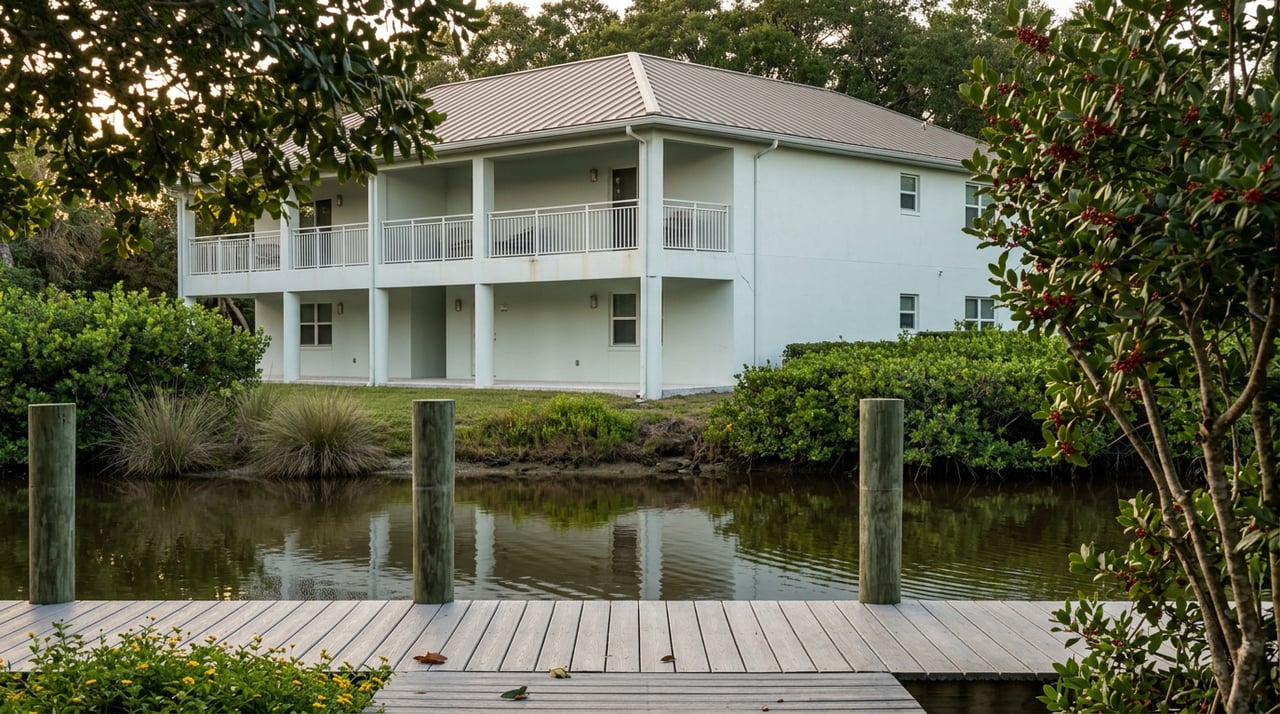
Why does a Navarre Beach condo with a Gulf view and a solid rental history sit longer at the loan desk than an almost identical unit two bridges over in Orange Beach?
It's a question more buyers should ask before they fall in love with the price. Navarre Beach routinely posts lower price-per-square-foot numbers than its Alabama neighbors, and it's easy to read that gap as a deal. Some lenders read it differently. So does the county tax roll. So does the calendar, once you know what date to look for.
The reason has nothing to do with the beach, the building, or the finishes. It has to do with what you're actually buying underneath them.
Almost everything standing on Navarre Beach, from the high-rise towers on Gulf Boulevard to the single-family homes on the canals, sits on land the owner doesn't own. Escambia County holds title to the whole island and leases it to Santa Rosa County under a 99-year agreement that began in 1956. Santa Rosa County then sub-leases individual parcels to homeowners and condo associations. When you close on a property here, you're buying the structure. The dirt underneath stays leased.
This is why the listing description says "leasehold" in the fine print and why a title search on Navarre Beach reads differently than one in Gulf Shores or on Ono Island, where buyers hold fee-simple title outright. It's a structural fact of the island, not a quirk of any one building, and it shapes almost everything else on this list.
The most immediate friction point isn't the tax bill or the HOA packet. It's the loan application.
Some conventional lenders scrutinize leasehold property more closely than fee-simple property, and condo buildings that operate heavily as short-term rentals, sometimes called condotels, tend to draw even more questions about reserves, occupancy, and rental income documentation. Investors buying with rental income in mind often route around this by using DSCR loans, which qualify the property on the rental income it produces rather than the buyer's personal tax returns. That workaround is common enough on Navarre Beach that local mortgage brokers advertise it specifically for Gulf-side investment purchases.
None of this means financing is unavailable. It means the underwriting conversation is longer, the documentation list is different, and a buyer who assumes their Orange Beach pre-approval will transfer cleanly to a Navarre Beach unit may be surprised at the closing table.
Here's the part that trips people up: not owning the land doesn't mean you skip the property tax on it.
For decades, Navarre Beach leaseholders paid no ad valorem property tax at all, an arrangement that dated back to the island's earliest development years. That changed in 2014, when the Florida Supreme Court ruled that leasehold improvements on Navarre Beach and Pensacola Beach were subject to full county property tax, settling a dispute that had worked its way through the courts for years. Leaseholders now pay property tax like any fee-simple owner, on top of the land lease payment itself.
That lease payment, by comparison, is small. Reported figures put it around $250 a year, a rounding error next to a six-figure purchase price. The tax bill is where the real cost lives, and it's calculated the same way it would be if you owned the land outright.
Leaseholders and both county commissions have pushed for years to convert Navarre Beach parcels to fee-simple title, a change that would resolve a lot of the friction described above at once. The effort has real institutional backing. The Navarre Beach Leaseholders & Residents Association has advocated for it directly, and Escambia and Santa Rosa counties have both passed resolutions supporting the conversion.
As of mid-2026, it still hasn't happened. The path requires an act of Congress, since the original 1946 federal deed to Escambia County restricted the land from ever being resold, only leased. Legislation has cleared one chamber before without finishing the process, and the most recent local reporting on the effort describes it as still moving, not resolved. Buyers should treat fee-simple conversion as a possibility worth watching, not a fact they can lean on before closing.
Here's the calculation that matters most and rarely gets said out loud: the master lease behind all of this runs from 1956 for 99 years. That puts its expiration in 2055.
From today, that's 29 years away, which is close to the length of a 30-year mortgage taken out this year. A buyer signing a standard 30-year loan on a Navarre Beach property in 2026 could be making payments on a home that outlasts the lease structure it currently sits on, unless the individual parcel sub-lease has its own separate term or the fee-simple conversion finally clears Congress in the meantime.
This is the single most useful question a buyer can ask before writing an offer: what is the actual remaining term on this specific parcel's sub-lease, not just the master lease date. A closing attorney or title company working Navarre Beach regularly can answer that in a phone call. Skipping the question means finding out the hard way, potentially decades from now, exactly how a lease structure interacts with resale and refinancing near its end.
One more piece of the puzzle: Navarre Beach has no single homeowners association covering the whole island. Each condo building runs its own association, sets its own fees, and manages its own reserve fund and rental rules. A well-funded, resident-heavy building on the Sound side can look nothing like a heavily short-term-rented tower on Gulf Boulevard, even if both sit a few hundred yards apart.
That split matters for anyone comparing units. A buyer who assumes Navarre Beach condo ownership is one uniform product is skipping the diligence step that actually determines whether a specific building is a good long-term hold: its reserve study, its rental policy, and how often its board approves special assessments.
Recent closed-sale data for Navarre Beach, as of July 2026, put the median sale price around $862,000, or roughly $487 per square foot, based on a small pool of closings. That thin trading is exactly why price-per-square-foot is the steadier number to watch here rather than the headline median, since a single high-end closing can swing a small sample significantly.
The same data shows homes averaging about 139 days on market with roughly twelve months of supply, conditions that point to a buyer's market rather than a seller's one. Values are reported flat over the past year but up sharply, around 142 percent, since 2019, which tells its own story: the leasehold structure hasn't stopped appreciation over the long run, but it hasn't insulated the market from a slower current stretch either. Dated interiors reportedly still trade at a real discount to renovated units, meaning condition, not just the lease, is where a buyer can actually negotiate.
None of this means Navarre Beach is a bad buy. Plenty of owners have held property here for decades, rented it successfully, and sold at a profit despite the lease structure. What it means is that the lower price-per-square-foot number isn't free money sitting on the table. It's the market pricing in a set of real, knowable frictions: less flexible financing, a tax bill unaffected by the fact that you don't own the land, a decades-old conversion effort still pending, and a lease clock that a 30-year mortgage could genuinely outlive if nothing changes before 2055.
A buyer who asks about the remaining sub-lease term, checks the specific building's HOA health, and prices in the financing conversation up front is comparing Navarre Beach to Gulf Shores or Orange Beach honestly. A buyer who just compares the per-square-foot number is comparing two different kinds of ownership as if they were the same thing.
Does the lease affect homeowners insurance? Insurance underwriting typically follows the structure and its flood zone and construction, not the land tenure, but ask your carrier directly since leasehold status can appear in policy paperwork.
Can I get a conventional mortgage on a leasehold Navarre Beach condo? Often yes, though terms and lender scrutiny vary by building and by whether the property functions as a short-term rental. Getting pre-approved specifically for a leasehold, and specifically for that building's rental character, avoids surprises.
What happens if the master lease expires before fee-simple conversion passes? That scenario hasn't been tested at scale, since the 2055 date is still decades out and the conversion effort remains active. It's exactly why asking about your specific parcel's sub-lease term now, rather than assuming it mirrors the master lease, is worth the extra phone call.
If you're weighing a Navarre Beach purchase against fee-simple options in Gulf Shores, Orange Beach, or Perdido Key, the comparison is worth doing with someone who can walk the lease terms, the building-specific HOA health, and the financing conversation with you side by side. The team at Leigh McPherson works across both the Alabama and Florida sides of this coastline and can help you read what a listing price is actually telling you before you make an offer. Search All Homes to see what's currently available across both markets.
Stay up to date on the latest real estate trends.
Luxury Market Insights

Investor Intelligence
Listings
Bringing the Gulf Indoors on Alabama's Shore: Sunrooms and Three-Season Rooms for Orange Beach Properties.

Coastal Color That Thrives in Sand, Sun, and Salt Air in Orange Beach: Gulf Coast Gardening and Planting Tips.
It is an honor to not only help dozens of clients buy or sell their properties but also see so many of their stories play out and get to be a part of writing a chapter. We strive to always take care of our clients with thorough communication, strategic negotiation skills, local contacts for specialized professions, area knowledge, as well as a touch of style and grace.